

Application selection brief
Aluminum Selection for Transportation Components
Transportation aluminum selection connects component duty to alloy, temper, product form, joining route, corrosion system, and production control. A strong grade on a datasheet may still be a poor match for forming, extrusion, welding, fatigue, repair, or mixed-metal assembly. The RFQ should identify the component and process before it asks for an alloy alternative.
Selection inputs
Service conditions to define
- Component function, load spectrum, stiffness, fatigue, crash or impact duty, operating temperature, and allowable mass.
- Product route including sheet forming, plate machining, extrusion, forging, adhesive bonding, riveting, bolting, or welding.
- External and internal corrosion exposure, road salts, moisture traps, dissimilar-metal contact, coating, anodizing, and sealant strategy.
- Dimensional capability, surface class, downstream heat treatment, repair route, traceability, and production approval requirements.
Failure review
Risks the specification must address
- Choosing by tensile strength alone can overlook stiffness, fatigue, notch behavior, forming limit, weld-zone softening, corrosion, or repairability.
- Temper changes during forming, welding, paint bake, heat treatment, or service can alter the final properties of the component.
- Galvanic contact with steel, copper-bearing materials, fasteners, or conductive liquids can accelerate local corrosion without isolation and drainage.
- Extrusion die variation, residual stress, plate flatness, coil surface, or inconsistent grain direction can disrupt machining, forming, joining, and appearance.
Procurement matrix
Compare the service, material route, and evidence
| Component and process | Alloy family to review | RFQ controls |
|---|---|---|
| Formed body or enclosure sheet | 5xxx or 6xxx sheet families depending on forming, strength, joining, and paint-bake route | Alloy, temper, thickness, surface, forming direction, joining, corrosion, and bake cycle |
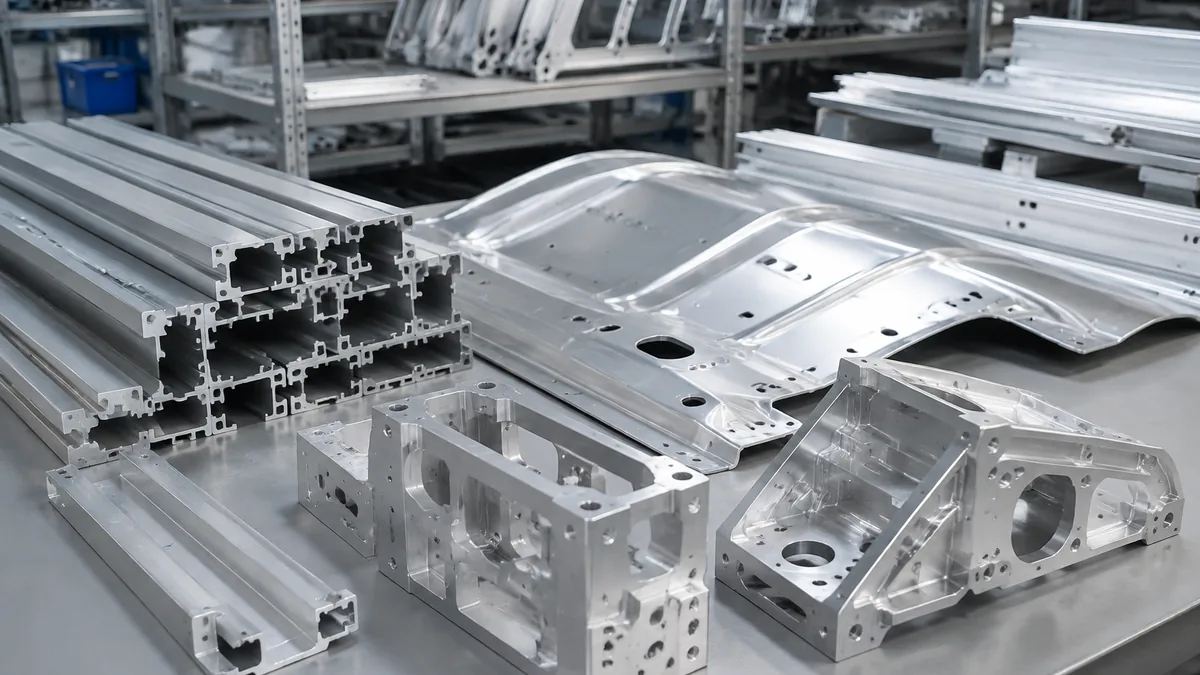
| Extruded structural or body member | 6xxx extrusion family with profile-specific temper and property requirements | Drawing, alloy, temper, mechanical zones, straightness, twist, surface, and joining |
| Machined high-strength plate or fitting | 2xxx, 6xxx, or 7xxx route as the design and corrosion review permit | Plate standard, temper, thickness, residual-stress condition, UT, machining allowance, and protection |
| Marine or road-salt exposed component | 5xxx or selected 6xxx family with system corrosion review | Environment, sensitization or temper limits when relevant, drainage, isolation, coating, and fasteners |
Acceptance package
Standards, inspection, and fabrication
Standards and inspection
- State the product standard, alloy, temper, form, thickness or profile drawing, dimensions, tolerances, surface, and any controlled revision.
- Define tensile and yield requirements, elongation, hardness or conductivity when relevant, grain direction, flatness, straightness, twist, and internal-quality testing.
- Specify certificate, heat or lot traceability, dimensional report, surface inspection, UT when required, and first-article or process approval handled by the project.
- Separate raw-material conformity from finished-component qualification, joining validation, crash approval, and regulatory certification.
Fabrication controls
- Provide forming radius, grain direction, forming simulation inputs, springback or flatness controls, machining allowance, extrusion drawing, and joining method.
- Review weld-zone property loss, filler and procedure responsibility, adhesive pretreatment, fastener isolation, paint-bake exposure, anodizing, and repair limits.
- For precision machining, identify residual-stress-reduced plate or other delivery condition only when supported by the product standard and design review.
Order-ready data
RFQ requirements
Send these fields together so technical review starts from one consistent specification.
Prepare an RFQ- 01
Component function, load and fatigue notes, temperature, corrosion environment, target mass, and governing specification
- 02
Product form, standard, alloy, temper, thickness or profile drawing, dimensions, tolerances, surface, and quantity
- 03
Forming, machining, extrusion, heat treatment, welding, bonding, fastening, paint bake, anodizing, and repair route
- 04
Mechanical, dimensional, surface, UT, conductivity or other tests, certificate, lot traceability, and approval records
- 05
Packing system, rack or bundle limits, destination, unloading, delivery sequence, and requested schedule
Frequently asked questions
Which aluminum series is used for transportation?
5xxx and 6xxx families are common starting points for sheet and extrusion, while 2xxx or 7xxx may be reviewed for selected high-strength parts. The component duty, form, joining, corrosion, fatigue, and qualification route decide the shortlist.
Why must the temper be included in an aluminum RFQ?
Temper records the mechanical and thermal condition. It affects strength, forming, machining, welding response, dimensional stability, and the properties expected after downstream processing.
Can aluminum contact steel directly in a vehicle assembly?
Mixed-metal joints need a corrosion review. Coatings, isolators, sealants, drainage, fastener choice, and repair procedures may be required for the actual environment.